 Domain NamesFind and register your ideal domain name instantly.
 Web HostingEasy-to-use hosting powered by cPanel — ideal for managing websites in Nigeria.
 Windows HostingRun .NET apps with Windows-optimized hosting
 Affiliate ProgramMake money promoting our services
 Reseller HostingMake money by reselling our hosting products under your own brand
 .COM Domains
 All DomainsExplore all supported tld domains in Nigeria
 WhoisFind out who owns any domain, as well as verify your registration details
 VPS Hosting in Nigeria
 Dedicated ServersReimagine your site speed with your own complete server
 Website BuilderDesign your site with drag-and-drop tools
 Online Store BuilderStart your online shop without code
 SSLs
SSLs Support PortalFind answers or get expert help
 Contact UsReach our team via chat or email
 BlogRead our extensive guides on web hosting and more
When it comes to running your software online, choosing the right SaaS hosting can feel a bit like picking the perfect home; it needs to be reliable, flexible, and able to handle everything you throw at it.
But with so many options out there, how do you know which one fits your business best?
Every founder wants their app to run smoothly, scale effortlessly as more users join, keep data safe, and fit within a budget that makes sense for a growing business.
That’s exactly what this guide is here for.
I’ll give you clear insights on what good SaaS hosting looks like and the features that match the demand, from performance and security to pricing and scalability.
That way, you’ll be able to make a choice that sets your software up for success, now and in the years to come.
What is SaaS Hosting?
SaaS (Software as a Service) hosting is a cloud-based model where a provider hosts applications on their servers and makes them accessible to users over the internet.

Instead of installing software on your own computer or server, users access it through a web browser or app on a subscription basis.
The hosting provider handles all the infrastructure, maintenance, and updates, so you can focus on building and growing your SaaS app rather than worrying about servers, backups, or downtime.
In 2026, this setup is especially important for Nigerian founders. The country’s cloud market is expanding rapidly.
So, good SaaS hosting ensures your app runs smoothly, scales as your user base grows, and keeps data safe, all while avoiding unexpected costs or technical headaches.
Key Features to Look for in SaaS Hosting
Choosing the right SaaS hosting can make all the difference between smooth growth and constant headaches.
Here are the essentials to prioritize:
- High uptime and reliability — Aim for 99.9% or more. Every minute your app is down could mean lost users and revenue.
- Scalable resources — Your hosting should automatically adjust CPU, RAM, and storage as your user base grows. You don’t want to scramble to upgrade when traffic suddenly spikes.
- Fast storage and performance — SSD or NVMe drives, plus CDN support, help your app load quickly, no matter where your users are in Nigeria or Africa.
- Strong security — SSL certificates, DDoS protection, firewalls, regular backups, and compliance-friendly setups keep your data and your users safe.
- Developer-friendly tools — Easy support for Python, Node.js, MySQL/PostgreSQL, SSH access, quick deployments, and one-click installers makes development smoother.
- Affordable pricing in Naira — Dollar-denominated bills can spike with exchange rates. Look for transparent pricing, unlimited bandwidth, and no hidden fees.
- Local support and data centers — 24/7 help that understands the Nigerian market, plus servers in Lagos or nearby, ensures low latency and faster fixes.
When your hosting ticks these boxes, it stops being a source of stress and starts supporting growth instead.
Why Nigerian SaaS Businesses Benefit from Local Hosting
Using an overseas host might seem fancy, but it can create real headaches in Nigeria.
Data traveling thousands of kilometers means slower load times and for SaaS apps like dashboards, real-time tools, or payment platforms, even a second of delay can cost users and revenue.
Payments add another layer of complexity.
Global providers charge in dollars, and with forex swings, a $20 plan can suddenly feel much heavier on your budget.
Regulations around data privacy also make local storage a big advantage, keeping user info secure and compliance simpler.
Unstable power and internet in Nigeria make foreign hosting even riskier if there’s no local backup.
Local providers solve this with servers in Lagos (or nearby hubs like Nairobi or Johannesburg), Naira-based pricing, fast support via WhatsApp, phone, or chat, and hybrid setups that keep apps running smoothly.
At Truehost, we built our SaaS hosting with these challenges in mind, with local data centers, pricing in Naira, and features designed for Nigerian founders who need reliability, speed, and peace of mind.
Top SaaS Hosting Options for Nigerians in 2026
For each, we’ll cover what they offer, their strengths, potential drawbacks for Nigerian users, and which types of SaaS apps they suit.
1. Truehost
Truehost’s infrastructure supports SaaS applications through server setups that give you performance, scalability, and tools you need to run real SaaS products.
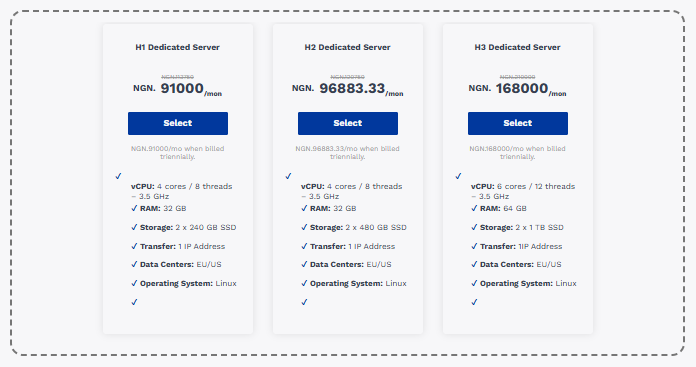
SaaS hosting is best supported on our Dedicated Servers, built for complete control and flexibility.
This setup is ideal for SaaS products that need full control over resources, consistent speed, and room to grow without sharing server power with other users.
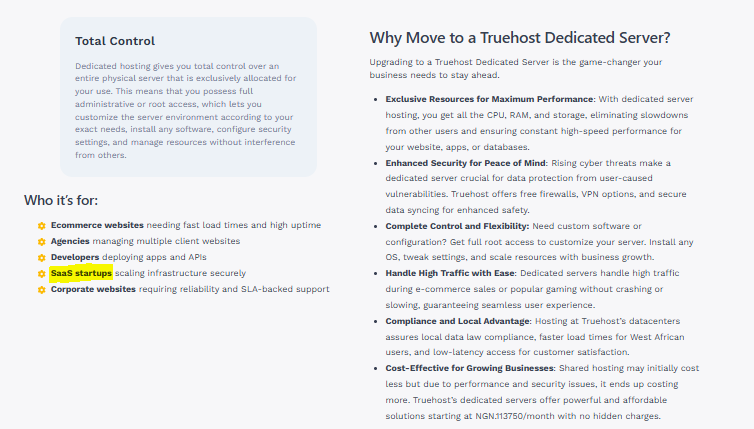
With a dedicated server, your SaaS app runs on hardware reserved entirely for you.
That means better performance for multi-user applications, smoother handling of subscriptions and databases, and more flexibility for custom Node.js or Python setups.
Truehost manages the infrastructure, security layers, and uptime, while you focus on improving your product and growing your user base.
Our dedicated servers are hosted with local and regional infrastructure, priced in Naira to avoid forex surprises, and supported by a team that understands Nigerian SaaS realities.
The plans are easy to pick based on how big your SaaS is.
For many early and scaling SaaS teams in Nigeria, this blend of local infrastructure and SaaS-friendly features makes Truehost a top choice.
We’re a strong fit for production-ready SaaS platforms, fintech tools, business software, and any application where reliability and data control matter.
For founders starting small, shared or VPS plans can work during testing.
But once your SaaS gains traction, moving to a dedicated server gives you the stability and performance needed to scale confidently.
2. DigitalOcean
DigitalOcean is a globally recognised cloud platform that many startups use to build and run SaaS products.
Its infrastructure is clearly built for SaaS workloads.
Founders can deploy backends, APIs, and services using virtual machines, managed databases, object storage, and a managed application platform that reduces server maintenance.
This flexibility makes DigitalOcean a strong choice for technical teams that want control over how their SaaS is architected and scaled.
Costs are predictable compared to larger hyperscale clouds, but billing is in dollars, which introduces forex risk for Nigerian founders.
There is also a steeper learning curve, as teams are responsible for setup, security configuration, and optimisation unless they rely heavily on the managed platform.
DigitalOcean works best for developer-led SaaS teams with global ambitions and the technical capacity to manage cloud infrastructure.
3. Kamatera
Kamatera positions itself clearly as a cloud infrastructure provider for SaaS workloads, offering highly customisable cloud servers that scale on demand.
Its platform allows founders to adjust CPU, memory, storage, and bandwidth as their SaaS usage grows, making it suitable for products with unpredictable traffic patterns or seasonal spikes.
The ability to choose hourly or monthly billing gives flexibility, especially during early testing or rapid growth phases.
Like DigitalOcean, Kamatera uses dollar-based pricing and international data centres, which can introduce both forex exposure and higher latency for Nigerian users if servers are not carefully located.
The platform is powerful but less beginner-friendly, with fewer hand-holding tools and more manual configuration.
Kamatera is best suited for technically experienced teams that want granular control over performance and scaling without committing to long contracts.
How to Choose and Get Started with Truehost SaaS Hosting
Here’s a simple roadmap to pick and launch your hosting plan:
1. Assess your needs — Estimate user numbers, database size, and growth. Start small if you’re bootstrapping.
2. Browse plans — Visit Truehost and check Starter for testing, Pro or Unlimited for scaling.
- WebHosting Starter: From ₦1,275/month (triennial, regular ~₦2,500). 30 GB SSD, unlimited bandwidth, around 25,000 visits/month, free .com.ng domain, automated SSL, daily backups, 1-click installer, Python/Node.js support, SSH, cPanel, and 99.9%+ uptime. Ideal for early-stage SaaS testing.
- WebHosting Pro: From ₦6,125/month (triennial). 50 GB SSD, around 50,000 visits/month, unlimited bandwidth, same features, perfect for growing SaaS with moderate traffic.
- WebHosting Unlimited: Around ₦9,300/month (triennial). Unlimited SSD storage, bandwidth, and websites, free migrations, AntiDDoS, WAF security, unlimited databases/emails/FTP, and 24/7 support. Great for scaling without limits.
3. Sign up — Use Naira payment options and take advantage of any promos like discounted .com domains.
4. Migrate or deploy — Use our free migration service or 1-click installer/SSH to launch your app.
5. Optimize — Enable SSL, set up backups, monitor with our tools, and scale as your subscribers grow.
Our team is ready to guide you at every step, so whenever in need just reach out.
Final Thoughts
Picking SaaS hosting in 2026 comes down to a few key things: reliability, speed, security, and pricing that fits Nigeria’s realities.
Local advantages make a huge difference: lower latency, easier payments, and smooth scaling without breaking the bank.
Truehost was built with these challenges in mind: affordable, packed with features, and always available when you need it.
Ready to power your SaaS growth? Head over to our dedicated servers hosting or basic web or VPS hosting, pick a plan, and get your app live.
Your subscribers are waiting.